Bristol: 01454 54 00 66
Chepstow 01291 76 99 66
Physio Clinic Bristol
  • Home
  • Book Now
  • Our Clinics
    • ​Physio Clinic Bristol
    • ​Physio Clinic Chepstow
    • Reviews
    • Our Privacy Policy
  • Therapy Services
    • Physiotherapy in Bristol & Chepstow
    • Physio Assessment plus Ultrasound Imaging
    • Womens Health Physiotherapy
    • Sports Therapy
    • Sports Massage
    • Shockwave Therapy
    • Post Operative Rehabilitation
    • Occupational Health Services
    • Patient Exercises Login
  • Running Hub
  • Sports Performance
    • Sports Massage
    • Sports Therapy
    • The Running Clinic
    • Matwork Pilates
  • Fees & Payment
    • Fees
    • Private Medical Insurance
    • Discount Rates for Sports Clubs
    • Special Offers
    • Terms and Conditions
  • More
    • Staff Profiles
    • Frequently Asked Questions (FAQ’s)
    • Chepstow Frequently Asked Questions (FAQ’s)
    • Our Clinical Expertise
    • Directions
    • Advice sheets
    • News and Articles
    • Useful Links – Our trusted partners
  • Contact
    • Contact Us
    • Job Vacancies
  • Click to open the search input field Click to open the search input field Search
  • Menu Menu
Blog - Latest News
DOMS

Am I Injured?

18th July 2019/in Uncategorised/by Pete Tang

What is DOMS, am I injured?

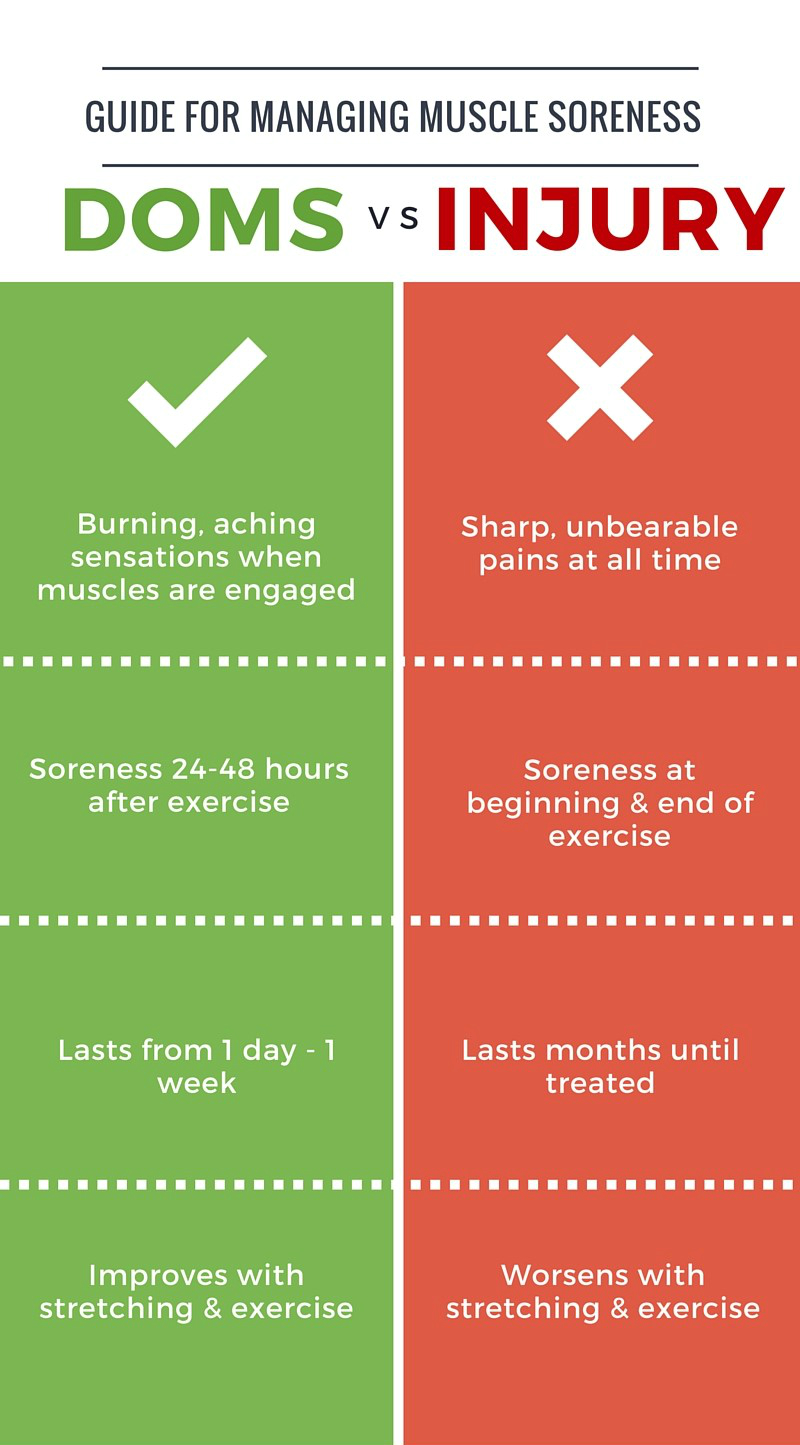
DOMS stands for Delayed Onset Muscle Soreness, and it occurs as a result of exerting your muscles. When you do an activity that is new, or you are working harder or for longer than usual, the extra stress on the tissues of your body causes micro trauma. These are microscopic tears in the fibres and occur widespread throughout the muscle groups being used.

This usually results in widespread soreness in one or multiple areas of your body 1-3 days after the activity, and the soreness can last quite a few days. This is totally normal. As these tiny microscopic tears heal they create slightly stronger muscles. It is important that our muscles go through this process in order to allow us to adapt and change, so we get better able to withstand the stresses of a new task in the future.

However, it is not possible to predict when DOMS will strike. Not everybody gets it and some people seem to suffer more than others. As a general rule it is more likely when starting out doing exercise, when doing something new, or when working harder than normal. This means as you keep training it does get better, you won’t always feel like that after exercise. For some this is reassuring to know it is possible to exercise and not feel sore the next day, and for others a lack of DOMS means they are due an upgrade to their program and should be working harder!
Certain types of exercise are more likely to cause DOMS than others. Typically exercises with a high eccentric load are more likely to cause soreness. Eccentric is the lowering phase of a muscle (or the deceleration phase), for example when you bring the weight back down towards your chest in a chest press.


This means that things like speed work, explosive/plyometric tasks, and repetitive high speed change of direction, all have a higher likelihood of causing soreness the next day. Clear examples of exercises with an eccentric focus would be jumping off of a box, or catching a heavy medicine ball.

Generally exercises will always have an element of concentric and eccentric demands, with other muscles working isometrically to control the movement, but you can modify them to increase or decrease the bias accordingly. This knowledge can allow you to control the amount of soreness you are likely to have following exercise. This information is also useful if you do not like DOMS. Doing a graded program that starts with basic isometric and steady concentric exercises and builds up in intensity and speed of movements slowly is more suited to managing DOMS.


There have been lots of studies into what we can do to reduce the soreness that occurs after exercise. The majority of which have shown there is very little we can do to shorten the length of time the soreness lasts. But there are things that we can do to make sure it does not last longer than normal. These include basic things like keeping active and moving around lots despite the soreness, do not repeat a hard activity or workout that targets the same area until the soreness has calmed down, drink plenty of water and eat well, and use things that usually give you a feel good effect (such as a hot bath or some gentle stretches). Some people who are training hard and need to recover as quickly as possible could also look into using the Compex for improved recovery. You are able to hire a Compex unit from The Physio Clinic to try it out.


When DOMS goes too far:

It is possible to create too much DOMS. Sudden extreme exercise can cause Rhabdomyolysis. This is rare and unlikely but possible. It causes extreme levels of post exercise soreness, rigidity (loss of range of movement due to rigid muscles), lack of urine or urine that is very dark in colour, and this takes longer to recover from that just DOMS.

It is due to excessive levels of microtrauma that results in high levels of creatine kinase in the blood and puts excessive stress on your kidneys. Unlike DOMS, Rhabdomyolysis is a serious condition that requires medical attention.

You need all the symptoms for it to be Rhabdomyolysis, if you are just excessively stiff and sore after exercise … you just have bad DOMS, plan better next time.

Share this entry
  • Share on Facebook
  • Share on X
  • Share on WhatsApp
  • Share on Pinterest
  • Share on LinkedIn
  • Share on Tumblr
  • Share on Vk
  • Share on Reddit
  • Share by Mail
https://www.thephysioclinicbristol.co.uk/wp-content/uploads/2019/07/f60195c3a645b4487f8e38ddd8e95a69-1.jpg 450 735 Pete Tang https://www.thephysioclinicbristol.co.uk/wp-content/uploads/2018/04/New-Physio-Clinic-Logo-test-1030x230.jpg Pete Tang2019-07-18 11:29:482019-07-18 11:29:48Am I Injured?

Latest News

  • Ironmman Journey – Blog 430th May 2025 - 12:47 pm
  • Ironman Journey – Blog 36th May 2025 - 9:39 pm
  • Ironman Journey – Blog 212th March 2025 - 1:00 pm

Get in Contact

We understand that people often don't know what we do or how we can help. Don't worry we're here to help.

To ask us a question or to book an initial appointment simply call 01454 54 00 66 for our Bristol Clinic or 01291 76 99 66 for our Chepstow Clinic and one of our friendly team will assist you with your enquiry.

Alternatively, please fill in the form on the Contact page.

Contact us

InstagramLinkedin-iconFacebook-icon

Facebook

[custom-facebook-feed feed=1]

Google
Isobel Jones
Google star 1Google star 2Google star 3Google star 4Google star 5Trustindex verifies that the original source of the review is Google.
After struggling for a year with debilitating lower back pain, chronic sciatica and being post-partum, Kate Moore (physio) has helped me tremendously. She has built not only my strength back but also my confidence through her detailed, caring and passionate support. She understands the challenges of everyday working/family life and helped me integrate the rehab into that.
Google
Maria Koo
Google star 1Google star 2Google star 3Google star 4Google star 5Trustindex verifies that the original source of the review is Google.
I booked in for a running analysis. Pete did a really comprehensive assessment on my recurrent ankle issues and explained things in a lot of detail to help me understand the underlying reasons for my injuries. He gave me the confidence to try running again and equipped me with the knowledge to prevent further injuries. I have seen running specialists / physios / podiatrists in the past but I felt this was the best assessment I’ve had yet. Thanks!
Google
Rona Volkmer
Google star 1Google star 2Google star 3Google star 4Google star 5Trustindex verifies that the original source of the review is Google.
The Physio Clinic was very helpful when I thought I had sciatica. Craig found out what the problem was and gave me advice as well as exercises to do at home. Booking sessions was straightforward.
Google
Alex T
Google star 1Google star 2Google star 3Google star 4Google star 5Trustindex verifies that the original source of the review is Google.
Saw Pete Tang at the clinic about a knee injury I'd had for a year, which another physio had struggled to properly diagnose or help with. Got a detailed diagnosis on my first visit in June along with an evolving exercise programme and was improving within a month and able to run a half marathon within three. Pete was knowledgeable, friendly and helpful and went through more advanced treatment options if the injury didn't respond – but did not push these and after three sessions told me I was good to go unless things worsened. Highly recommended – thanks!
Google
Susan Budge
Google star 1Google star 2Google star 3Google star 4Google star 5Trustindex verifies that the original source of the review is Google.
I was very happy with the treatment I received from Dave and would definitely recommend.
Google
E J
Google star 1Google star 2Google star 3Google star 4Google star 5Trustindex verifies that the original source of the review is Google.
Just had a neck and shoulder sports massage with Luke—highly recommend! He quickly found the problem areas and used the perfect pressure to release tension. I noticed a big difference straight away and felt so much better after. Luke is friendly, professional, and clearly knows his stuff. Would definitely book again!
Google
Pauline Iles
Google star 1Google star 2Google star 3Google star 4Google star 5Trustindex verifies that the original source of the review is Google.
I had three months of physiotherapy with Dave Mercy starting in June 2025 to help rehabilitate my right foot following a medically necessary operation to break and re-position my heel bone following a diagnosis tibialis posterior tendinopathy with a split tear. The physiotherapy started approx three months after surgery. Dave helped me to progress from being in an air-cast boot on my first visit and unable to put my weight through my foot, onto massages to reduce and eventually eradicate the post surgical swelling in my foot, onto a range of exercises in the gym to exercise, stretch and strengthen my foot and allow me to complete everyday activities that I can now once again enjoy. The support that Dave provided was comforting in the early days and then as the gym exercises progressed, Dave was encouraging and challenged me to develop my foot strength, flexibility, and gave me the confidence to put my full weight through my foot and complete a wide range of exercises that I didn’t think would be possible. I am walking well and whilst the finer aspects of my foot recovery will take longer to achieve, for now I can walk without the pain I previously had, which is a massive achievement. Thanks Dave, you had a hugely positive impact on my level of recovery!
Google
Jim Godden
Google star 1Google star 2Google star 3Google star 4Google star 5Trustindex verifies that the original source of the review is Google.
Excellent service, very quick to get me an appointment. Katie did a very good massage on my back and calves - I feel better already :-)
Google rating score: 4.9 of 5, based on 282 reviews

View More Testimonials

Search the Website

Search Search
© 2026 The Physio Clinic Bristol - Website by Blaze Concepts
  • Privacy Policy
  • Cookie Policy
  • Sitemap
Link to: What is shockwave treatment and how does it work. Why we choose to use it here at the clinic as a treatment method Link to: What is shockwave treatment and how does it work. Why we choose to use it here at the clinic as a treatment method What is shockwave treatment and how does it work. Why we choose to use it here... Link to: Acupuncture vs Dry Needling – What’s the difference? Link to: Acupuncture vs Dry Needling – What’s the difference? Acupuncture vs Dry Needling – What’s the difference?
Scroll to top Scroll to top Scroll to top