Physiotherapy Assessment with Ultrasound Imaging.
See more. Understand more. Make informed decisions.
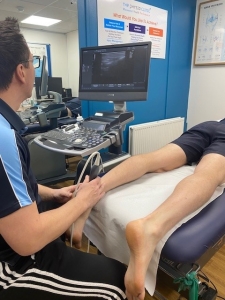
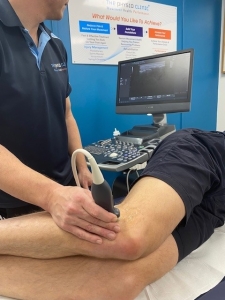
Our physiotherapy assessment with ultrasound imaging combines a comprehensive physiotherapy assessment with a Point of Care Ultrasound Scan (POCUS) allowing us to look at the relevant tissues in real time as part of your appointment.
The aim isn’t simply to “have a scan”. Ultrasound is used when it can provide useful additional information to support our clinical assessment and help us make better-informed decisions about your treatment.
What can ultrasound scanning be useful for?
Musculoskeletal ultrasound can be helpful when assessing certain tendon, muscle and other superficial soft-tissue problems including:
- Tendon problems – such as the achilles, patella, rotator cuff, hamstring and other accessible tendons
- Muscle injuries – where we may want to assess the location and extent of a muscle injury or tear
- Ligament injuries – such as ankle sprains and knee sprains to grade the extent of the injury and guide early management.
Do I need an ultrasound scan?
Not every injury needs imaging, and more imaging doesn’t necessarily mean better care. Almost all musculoskeletal problems can be confidently assessed and diagnosed through a detailed history and physical examination.
For problems such as back pain, neck pain or joint symptoms where deeper structures or bones need investigating, ultrasound may not be the most appropriate form of imaging. Where necessary, we can discuss whether another investigation, such as x-ray or MRI would be more appropriate.
If you’re unsure whether you need a scan, please give us a call to discuss or book a standard physiotherapy assessment. If a scan would be appropriate this can be arranged at another appointment.
What happens during the appointment?
Your appointment is first and foremost a physiotherapy assessment.
We’ll discuss your symptoms, medical history and carry out a physical examination. Ultrasound imaging can then be incorporated where it is clinically useful.
We’ll explain what we can see, what the findings may mean in the context of your symptoms and examination findings, and – just as importantly – what they don’t tell us.
Your assessment can then be used to help guide the next steps which may include hands on treatment, exercise, further investigations or onward referral where appropriate.